
Search Michigan Traffic Court Records
Michigan traffic court records are created when traffic violations move through the state's district courts. Each of Michigan's 83 counties has at least one district court that handles everything from minor speeding tickets to serious misdemeanor traffic charges. You can search these records for free through MiCOURT, the state's online case search system, which covers most participating Michigan courts. Records show case status, dispositions, and more. This page covers how to find Michigan traffic court records, what they include, and how to get official copies.
Michigan Traffic Court Records Overview
How to Search Michigan Traffic Court Records
The main tool for searching Michigan traffic court records is MiCOURT. This free portal is run by the Michigan Supreme Court and pulls case data from most district, circuit, and probate courts across the state. You can search by case number, party name, or attorney. Results show the case type, status, scheduled events, dispositions, and payment balance. Go to micourt.courts.michigan.gov/case-search to start your search.
To use MiCOURT, you need at least one piece of identifying information. A case number gives you the most direct result. If you don't have one, a full name search works for most cases. You can filter by case status, which helps narrow results if someone has multiple records. Traffic cases, criminal cases, civil matters, and probate records are all searchable through the same portal. Not every court in Michigan participates fully, so some older records may require an in-person visit.
The Michigan Courts official website has links to individual court websites, local rules, and court contacts. If MiCOURT doesn't return the result you need, the Michigan Courts site can point you to a specific court's own search tools. Several counties run separate case inquiry systems in addition to MiCOURT.
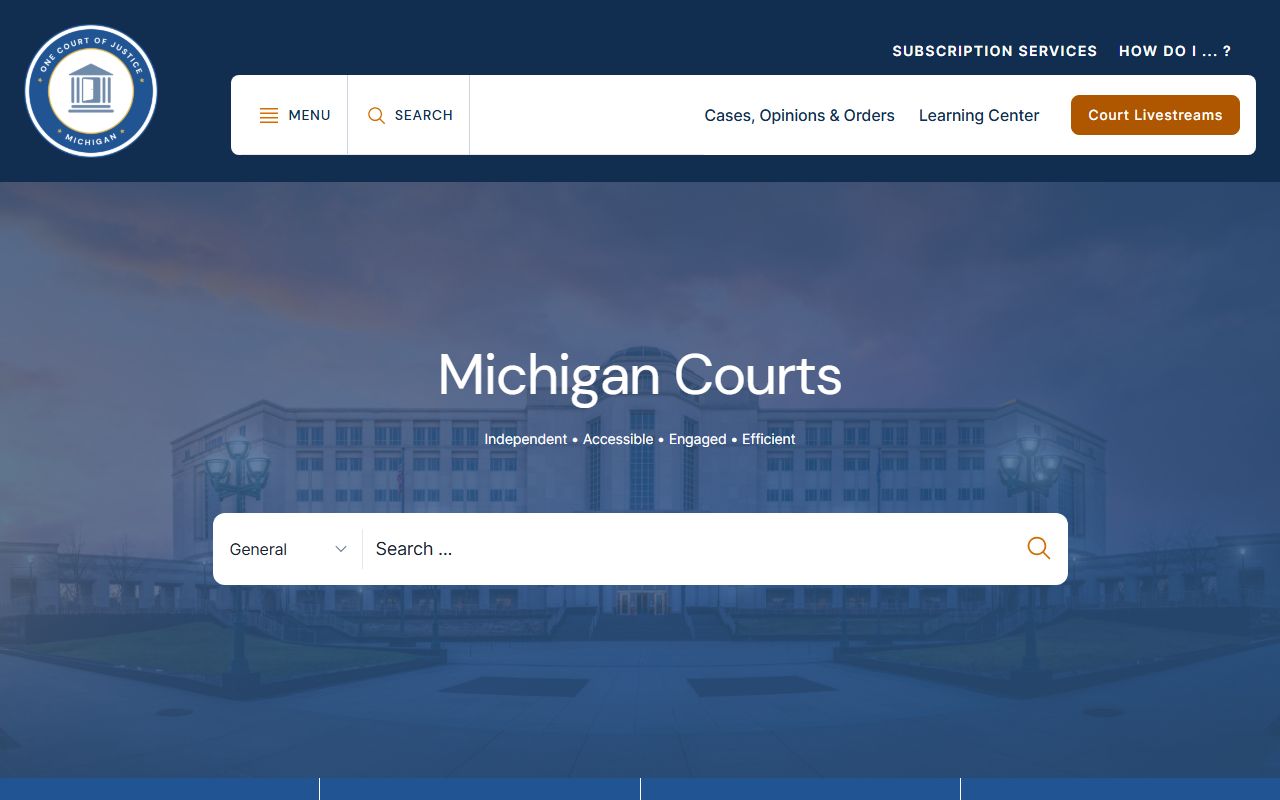
The Michigan Courts website at courts.michigan.gov is the central hub for court information, including links to local court websites and the MiCOURT search portal.
Michigan's MiCOURT Online Case Search
MiCOURT launched as a statewide case management and public access system. It replaced older local systems in many counties and created one consistent search experience for the public. Most Michigan district courts now participate, which means traffic records from courts across the state are accessible in one place. You can filter results by case type, so you can look specifically at traffic cases without wading through civil or criminal results.
There are some things MiCOURT won't show. Under Michigan Court Rule MCR 1.109, date of birth does not appear in public record searches as of April 1, 2022. Sealed cases, cases set aside under Michigan's Clean Slate laws, certain drug charges under MCL 333.7411, and cases disposed under the Holmes Youthful Trainee Act (HYTA) are also not visible online. Juvenile traffic and delinquency matters are restricted. If you're looking for a record and it doesn't appear, those restrictions may be why.
MiFILE is the companion e-filing portal for Michigan courts. Attorneys and parties can file documents electronically for cases in participating courts. The list of courts that accept e-filing through MiFILE is at mifile.courts.michigan.gov/availablecourts. This is separate from MiCOURT's search function but is part of the same statewide court technology system.
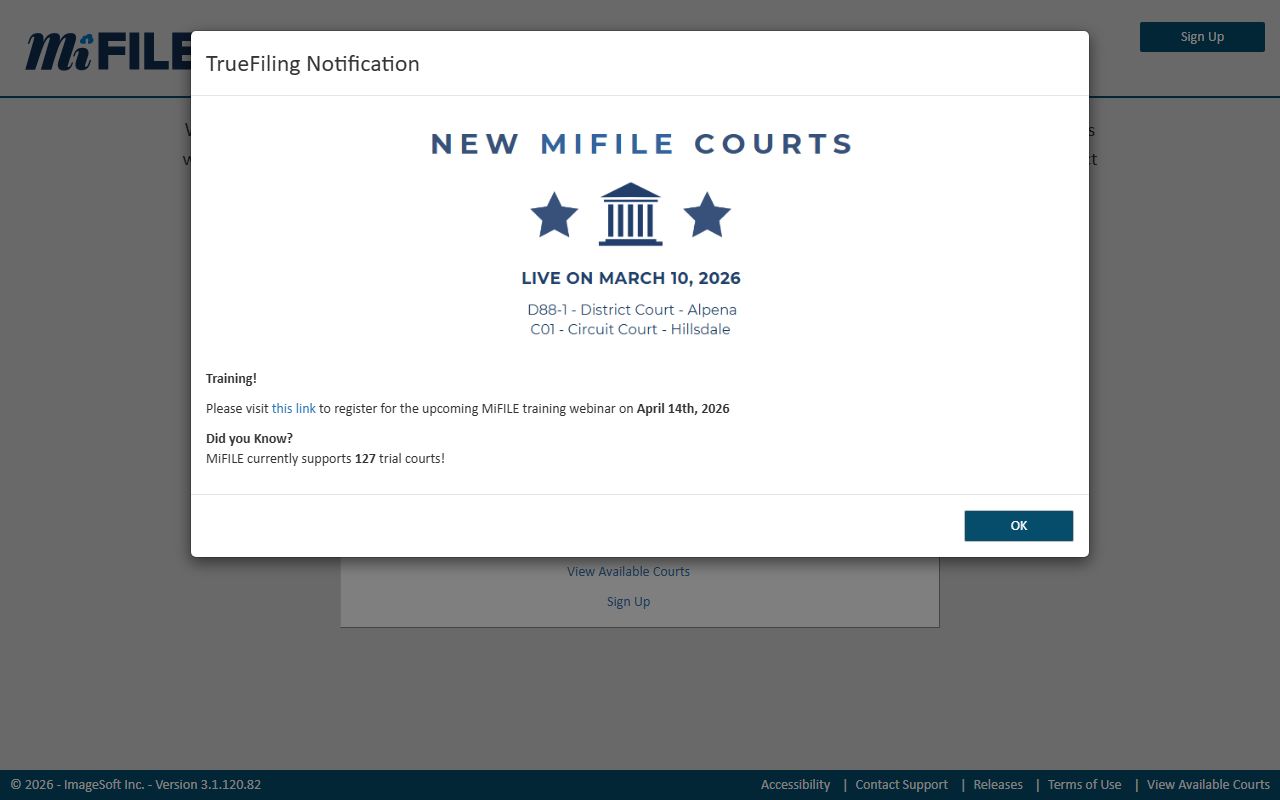
Michigan's MiFILE portal at mifile.courts.michigan.gov handles electronic document filing for courts that participate in the statewide e-filing program.
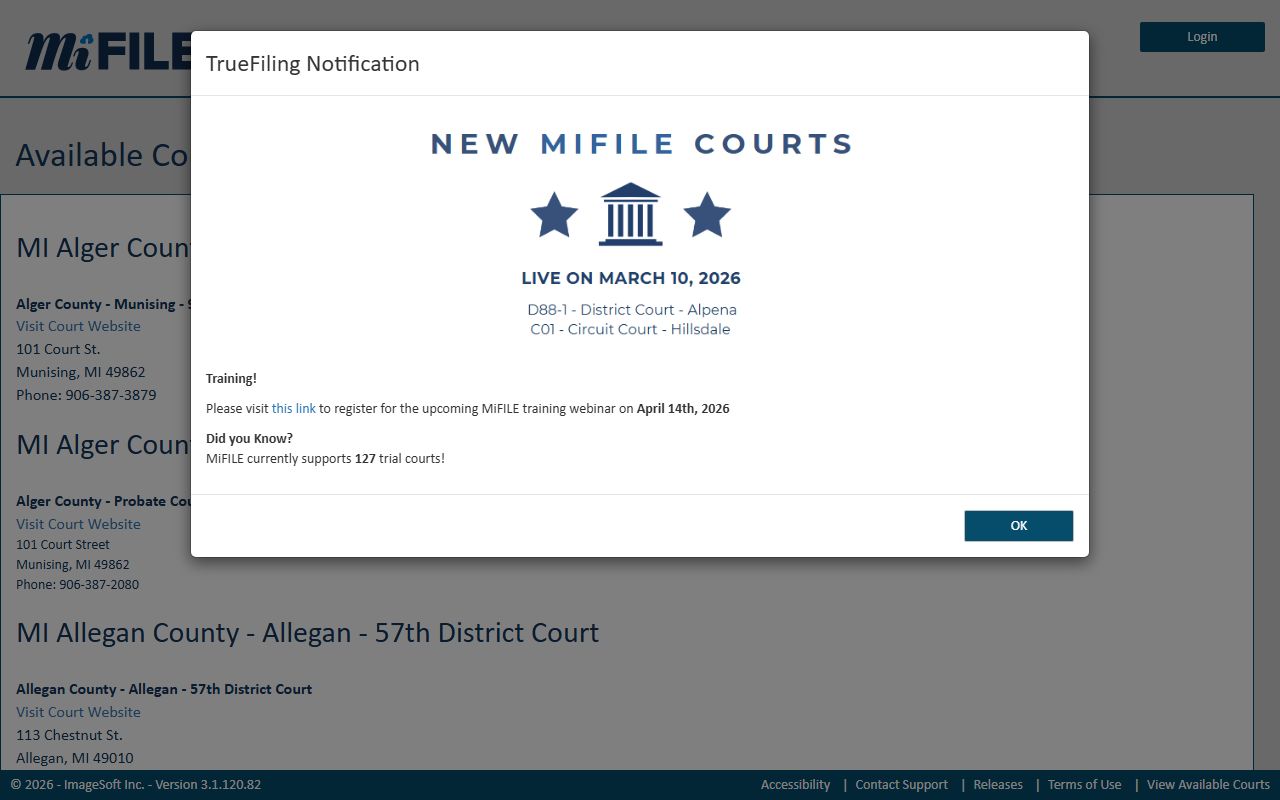
The MiFILE available courts page shows which Michigan courts accept electronic filings, covering district, circuit, and probate courts statewide.
What Michigan Traffic Court Records Contain
Traffic court records in Michigan are created at the district court level. When a ticket is issued, a case file opens. That file grows as the case moves through the court process. The final record shows what happened from citation to resolution. Courts are required to maintain these records under MCL 600.1428, which sets standards for how clerks keep case files.
A standard Michigan traffic court record includes the citation number and date, the violation type and statute code, the name of the issuing officer, defendant information, vehicle details, and all case events in the register of actions. The disposition shows whether the defendant admitted responsibility, contested the ticket, or had the case dismissed. If fines and costs were assessed, those amounts and the payment history are part of the record. For misdemeanor traffic offenses like operating while intoxicated under MCL 257.625, the record also includes arraignment dates, sentencing details, and any probation terms.
One thing courts do not control is points on a driving record. Points are assessed by the Michigan Secretary of State, not by the court. The court notifies the Secretary of State of the plea or finding, and the Secretary of State updates the driving record. To see official driving record points, contact the Michigan Secretary of State or request a copy of your driving record through their Commercial Look-up Unit at 517-322-1624.
The Michigan Secretary of State maintains official driving records and handles point assessments for traffic violations statewide.
Traffic Violation Response Options in Michigan
When you get a traffic ticket in Michigan, you have several ways to respond. Most civil infraction tickets give you 14 days to respond. If you don't respond in time, a default judgment is entered against you. That means points go on your record, fines are assessed, and the Secretary of State may suspend your license. Reinstating a suspended license comes with a fee on top of all the original costs.
You can admit responsibility and pay the fine. This is the fastest option. You can also admit responsibility with an explanation. That means you write a statement, and a magistrate reviews the circumstances before deciding the outcome. Some people use this option when there are mitigating factors they want the court to consider. Denying responsibility triggers a hearing. An informal hearing is held before a magistrate without attorneys, and you can appeal within 7 days. A formal hearing is before a judge, attorneys are allowed, and the officer who issued the ticket will be present.
Michigan courts are prohibited by law from taking traffic matters "under advisement." This means a court cannot simply set a case aside without a formal resolution. Every traffic case must be decided. Judges also cannot waive or change the points the Secretary of State will assess. Courts report the outcome to the Secretary of State, and the Secretary of State applies the appropriate points based on the violation.
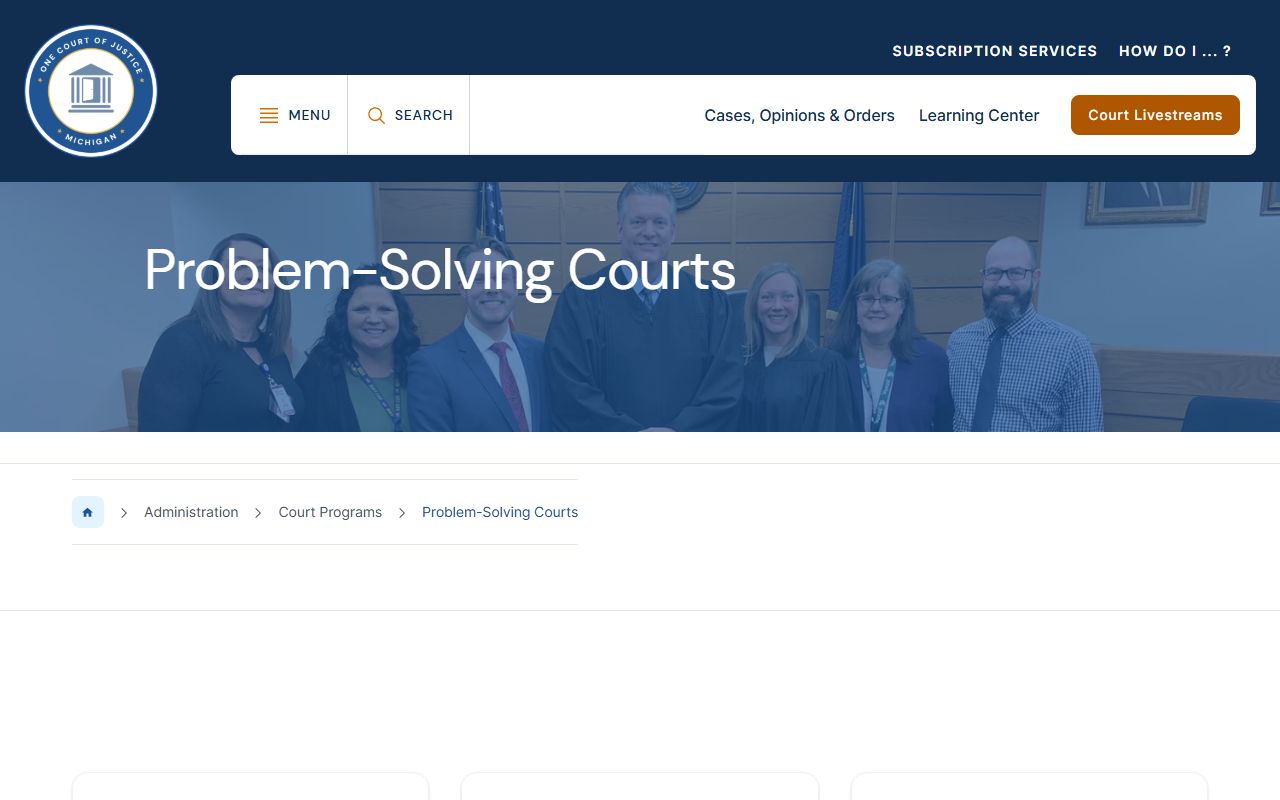
Michigan's problem-solving courts, including sobriety courts, are available in many counties and serve defendants with serious traffic-related offenses like OWI.
Michigan Driving Point System
Michigan uses a point system to track how drivers perform over time. Points attach to convictions and stay on your record for two years from the conviction date. Accumulating 12 or more points within a two-year period triggers a driver reexamination by the Secretary of State. At that reexamination, the Secretary of State can restrict, suspend, or revoke your license. The point values vary by offense type.
The most serious violations carry 6 points each. These include operating while intoxicated, reckless driving, fleeing or eluding a police officer, failing to stop at the scene of an accident, and manslaughter or negligent homicide involving a motor vehicle. Speeding violations range from 3 points (1-10 mph over the limit) to 4 points (11-15 mph over) to 5 points (16 or more mph over). Most other moving violations carry 2 points. Disobeying a traffic signal, improper passing, and failure to stop for a school bus each carry 3 points.

The Michigan trial courts directory at courts.michigan.gov lists every district, circuit, and probate court in the state along with contact information and links to local court websites.
Getting Copies of Michigan Traffic Court Records
You can view basic case information for free through MiCOURT. Getting physical copies of court documents costs money. The standard fee at most Michigan district courts is $1.00 per page for regular copies. Certified copies typically cost $10.00 for the first page plus $1.00 for each additional page. Transcript fees are set by state statute under MCL 600.2543 at $3.75 per original page, with a $50 minimum charge. Courts may also charge for searches when no case number is provided.
You can request records in person at the courthouse, by mail, or in some courts by email or fax. In-person requests are usually the fastest. Bring a government-issued photo ID and know the case number or the name and approximate date of the case. For mail requests, include a self-addressed stamped envelope and a check or money order payable to the court. Do not mail cash. Most courts ask you to allow 5-10 business days for mail requests to be processed.
If you need records that aren't accessible through normal request channels, you may submit a FOIA request under Michigan's Freedom of Information Act, MCL 15.231 et seq. The court's FOIA coordinator must respond within 5 business days. For complex requests, courts can extend the deadline by up to 10 additional business days with written notice. The first $20 in fees is waived for individuals on public assistance who submit an affidavit of indigency.
For criminal background checks related to traffic offenses, the Michigan State Police ICHAT system provides criminal history records for a $10 fee per search.
Browse Michigan Traffic Court Records by County
Michigan has 83 counties, each served by at least one district court that handles traffic violations. Select a county below to find court contact info, local case search tools, and record request details.
Browse Traffic Court Records by City
Major Michigan cities each have a district court that handles local traffic cases. Select a city to find the court, case search tools, and how to request records.